[Leetcode] 133. Clone Graph
Given a reference of a node in a connected undirected graph.
Return a deep copy (clone) of the graph.
Each node in the graph contains a value (int) and a list (List[Node]) of its neighbors.
class Node {
    public int val;
    public List<Node> neighbors;
}
Test case format:
For simplicity, each node's value is the same as the node's index (1-indexed). For example, the first node with val == 1, the second node with val == 2, and so on. The graph is represented in the test case using an adjacency list.
An adjacency list is a collection of unordered lists used to represent a finite graph. Each list describes the set of neighbors of a node in the graph.
The given node will always be the first node with val = 1. You must return the copy of the given node as a reference to the cloned graph.
Example 1:
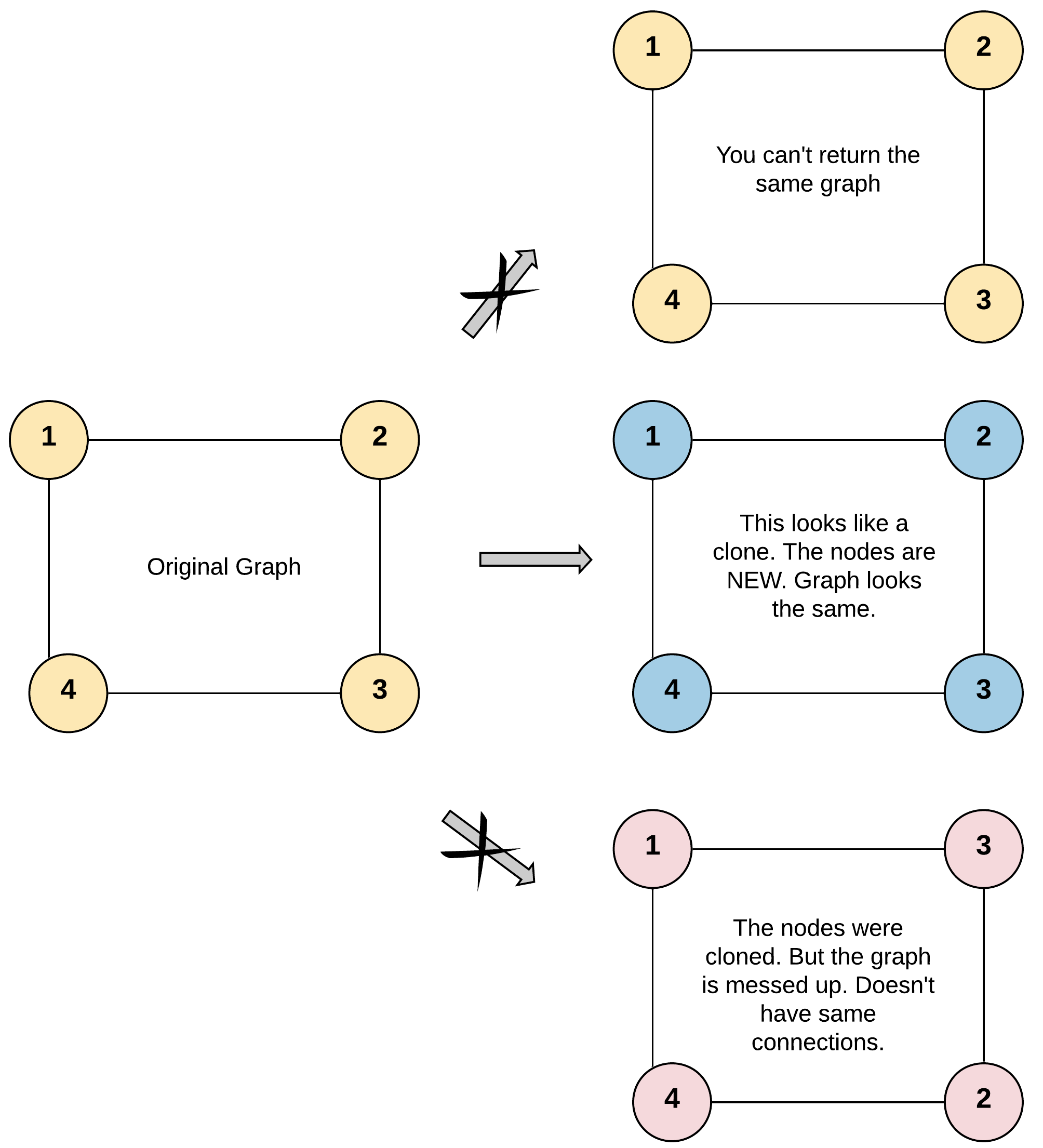
Input: adjList = [[2,4],[1,3],[2,4],[1,3]]
Output: [[2,4],[1,3],[2,4],[1,3]]
Explanation: There are 4 nodes in the graph.
1st node (val = 1)'s neighbors are 2nd node (val = 2) and 4th node (val = 4).
2nd node (val = 2)'s neighbors are 1st node (val = 1) and 3rd node (val = 3).
3rd node (val = 3)'s neighbors are 2nd node (val = 2) and 4th node (val = 4).
4th node (val = 4)'s neighbors are 1st node (val = 1) and 3rd node (val = 3).
Example 2:
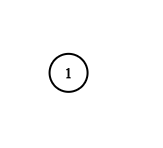
Input: adjList = [[]]
Output: [[]]
Explanation: Note that the input contains one empty list. The graph consists of only one node with val = 1 and it does not have any neighbors.
Example 3:
Input: adjList = []
Output: []
Explanation: This an empty graph, it does not have any nodes.
Constraints:
The number of nodes in the graph is in the range [0, 100].
1 <= Node.val <= 100
Node.val is unique for each node.
There are no repeated edges and no self-loops in the graph.
The Graph is connected and all nodes can be visited starting from the given node.
How to understand?
There is a connected graph, clone the graph from the given adjacent list.
How to approach?
DFS
class Solution:

    def cloneGraph(self, node: Optional["Node"]) -> Optional["Node"]:
        if not node:
          return None

        oldToNew = {}

        def dfs(node):
            if node in oldToNew:
                return oldToNew[node]

            copy = Node(node.val)
            oldToNew[node] = copy

            for nei in node.neighbors:
                copy.neighbors.append(dfs(nei))

            return copy

        return dfs(node)
- create Old to New dictionary. key will be node and value will be cloned node
- create dfs function takes node as input
- when the node is in the dictionary, return the value of the key.
- create copy using Node class and node.val.
- and put node as key and copy as value.
- create for loop to use the neighbor in node.neighbors
- append the result of the dfs(neighbor) to the copy's neighbors.
- and return the copy in dfs function.
- lastly return the dfs(node) result if node does exist.
BFS
class Solution:

    def cloneGraph(self, node: Optional["Node"]) -> Optional["Node"]:
        if not node:
            return None

        cloned = {}
        cloned[node] = Node(node.val, [])
        queue = collections.deque([node])

        while queue:
            curr = queue.popleft()

            for neig in curr.neighbors:
                if neig not in cloned:
                    cloned[neig] = Node(neig.val, [])
                    queue.append(neig)

                cloned[curr].neighbors.append(cloned[neig])


        return cloned[node]
- create cloned dictionary
- and put node key with the value using Node class and node.val
- create queue to put the first value as [node] since deque expects iterable list.
- while condition to check the queue has items to check.
- pop left the item in the deque and set it as curr
- for loop to check the current items' neighbor
- when cloned doesn't have the neighbor in it, it will create the Node using neig.val and put it as value of the key neig in cloned.
- and append the neig in queue
- in for loop, append the cloned[neig] in cloned's current item's neighbors list⇒"Append the cloned version of the neighbor (
cloned[neig]) to the cloned version of the current node (cloned[curr])'s neighbor list." - return the cloned[node] lastly.